Everything, Everywhere, All at Once
The future is ADHD
February 2020
It’s my mother’s birthday and we have decided as a family to watch a romcom called About Time. The film’s protagonist has the ability to travel back in time to any moment in his life. Over the course of watching it, I slowly come to the horror-inducing realisation that I don’t have time travel powers. This, of course, implies that every second of my life is a second I will never be able to redo. An existential crisis ensues.
I begin re-evaluating the ways I’m spending my time: I reduce my passive consumption of content from the internet and begin working on programming projects and reading into existentialist philosophy: Camus, Sartre, Kierkegaard, Nietzsche. I decide I want to do something remarkable with my life, and there’s no time to waste.
I can sense the edges of my potential collapsing inwards through each passing moment, every choice made. My days are accompanied by a background hum of anxiety.
March 2023
I watch Everything, Everywhere All at Once for the first time. I shed some tears at the emotional climax of the film - a rare occurrence for me. I cry just as much at the same scene when I watch it years later.
I don’t consider myself to be someone who has a favourite film (for reasons you can find here), but if I was forced to give one, it would probably be this.
December 2023
Late at night, I begin reading a pirated PDF copy of Ted Chiang’s Exhalation. I am transfixed. Despite the fact that it has just passed 3am and I am feeling incredibly drowsy, I am unable to put it down.
My favourite story in the collection is titled Anxiety is the Dizziness of Freedom. It comes from a quote from Kierkegaard, describing the vertigo of staring down at the branching lines of possibility beneath you, and knowing that you could take any one of them; that your choices have resounding consequences which will follow you through the rest of your life.
Without spoiling too much, Chiang’s short story centres around a device that will flash red or blue depending on the outcome of a single quantum measurement, which (assuming the many worlds interpretation of quantum mechanics) essentially splits your current timeline into two distinct branching worlds. The device is built to allow you to communicate with your alternate timeline, and see what your life would have been like in your alternate reality.
July 2024
I receive the following texts from my closest friend at the time:
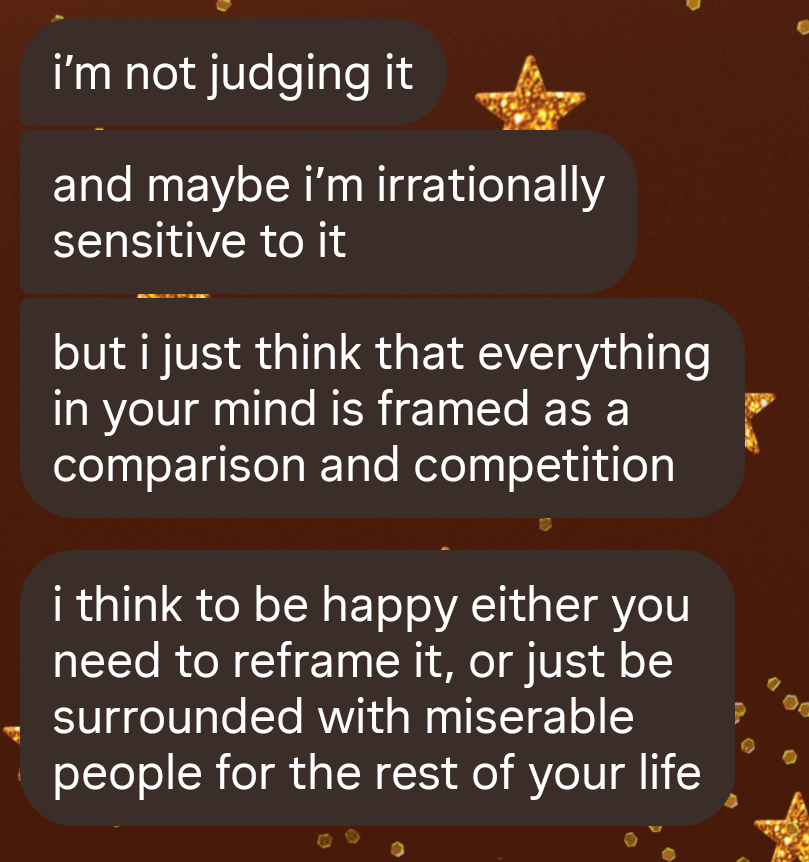
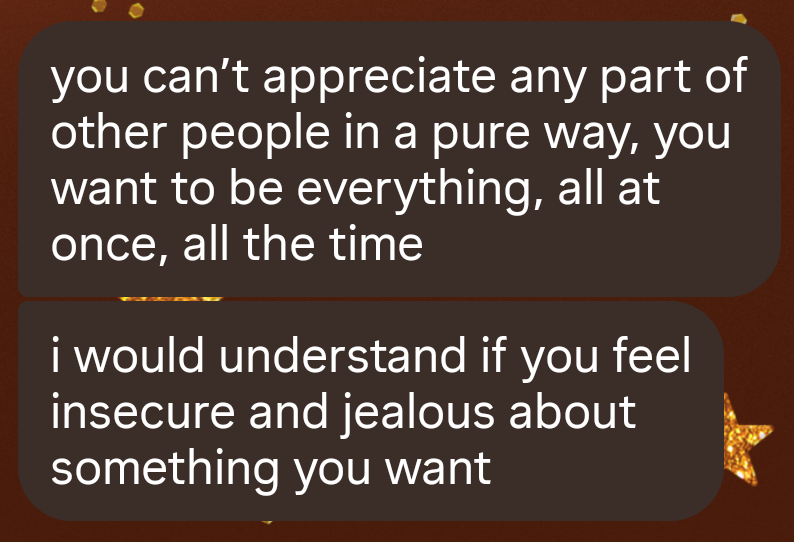
This haunts me for a while.
November 2025
I have taken a year out of university to work for a startup, doing AI research. The work itself is (mostly) fun and I am learning a lot, but it is also intense. I leave the office at 8:30pm on a good day and as late as 10:30 or 11pm on a not-so-good day.
I was explicitly taken on as a gamble, having had about 8 weeks of research experience and barely a month of production grade software engineering experience prior. I’m living in constant fear of losing my job (which I do at the end of the month, to my relief, after deciding it wasn’t worth fighting for anymore). I notice my mind actively constricting around the work - it becomes my world. I’m kept awake by stray thoughts, honing in on new ideas for experiments to try and techniques for making the systems better.
At lunch, I’m telling a colleague about the Ted Chiang story. I decide I want to build my own quantum random number generator that flashes red or blue depending on a quantum measurement. I can’t communicate with the alternative timelines like in the story; however, it can still offer some comfort to the indecisive: when I use it to make a decision, I can know there will be some other universe in which I explored the alternative.
I consider using it to make travel plans. Perhaps then, I will be able to do everything, everywhere, all at once.
January 2026
It’s 3:57 in the morning. The alcohol has mostly worn off by now, the sleep deprivation, not so much. I’ve just hosted a pretty successful new year’s eve party: I invited quite a wide mix of my friends from various places and they got along with each other surprisingly well.
I decide to do some reflection on the past year and I come to the realisation that though I may have done a lot on paper, in practice it has mostly been leaping from project to project, opportunity to opportunity without much of a driving thread or plan. Kierkegaard writes: “Were I to wish for anything I would not wish for wealth and power, but for the passion of the possible, that eye which everywhere, ever young, ever burning, sees possibility.” I saw a lot of possibility that year, but through this constant darting between projects, none of it really went anywhere.
And now, I see the paths ahead of me so clearly; I just need to seize one and bring it into reality. I need to stop trying to be everything, and decide to become something. 2025 has been a year of exploration and ideation; 2026 is going to be the year of execution.
March 2026
Miscellaneous Reflections It has recently occurred to me that I’m about halfway through my gap year. This is somewhat terrifying. I had so many hopes for what this year would look like. And don’t get me wrong, this has certainly been a pretty eventful 6 months (wtaf how has 6 months passed!!???), and has been great in many ways. But fundamentally, I think that right now, I am missing a lot of the intensity and directionality I expected of myself at this point. I feel like I’m drifting through my life, with a bunch of things I feel I have to do, but no real coherent vision or long-term plan…May 2026
I learn to slow down.
I’m staying at a castle in Czechia, trying to get confused about the alignment problem. I go for walks in the beautiful surrounding countryside, engage in interesting conversations, and give my mind some room to breathe. It’s one of the most intellectually generative environments I’ve ever been in.
Richard warns me against unrealistic half-baked plans driven by a sense of urgency and need to do something.
Jonas espouses the virtue of being a butterfly not a hedgehog.
I ask Kitt how I should deal with being torn apart so many different directions and projects I want to pursue at the same time. She tells me to look for the thread that brings them together, even if others can’t see it, and this will give it a sense of coherence.
The butterflies are sometimes just hedgehogs in disguise.
June 2026
Coercion is an adaptation to scarcity; trust is an adaptation to abundance.
In a world of scarcity, ideas are cheap and execution is costly. In a world of abundance, good ideas and agency are more often bottlenecks, and execution is getting exponentially cheaper.
I no longer have to choose between technical AI research, policy, philosophy, writing and the million other things I want to do with my time. Yesterday morning, I met with my MP in Westminster to discuss liability of AI systems. In the afternoon, I am back in Oxford and sent out a bi-directional interviewer system I had developed for the Idealists Collective. Later that evening, I work with a friend on a more theoretical blog post about patterns in the dynamics of optimising systems. Overnight, I have Claude running some experiments, testing ideas for some empirical safety techniques I’ve been thinking about. The results look promising enough that I expect I’ll be able to hand off to people I know to explore more rigorously. And today, I spend most of my time writing this piece on a whim.
I’ve finally learned that my brain was never meant to be caged. Anxiety is not the dizziness of freedom. It’s the fear of stepping out onto the edge - of not knowing, when it really matters, whether you’ll make the right choice. It’s the fear of trusting yourself.
My quantum random number generator project got postponed indefinitely, at least in this timeline. The components are still lying on my bedside table. Maybe one of these days I’ll pick it back up.