Taste
On my relationship with music
Such a feelin’s comin’ over me
There is wonder in most every thing I see
Not a cloud in the sky, got the sun in my eyes
And I won’t be surprised if it’s a dream
These are the opening lyrics of Top of The World by The Carpenters. In most circumstances, when I hear this song, I find it a bit irritating. I don’t listen to, or think about it very often. But something that I find hilarious is when I’m in a particularly great mood, I’ll sometimes notice that this song has been looping in my head for a while. And then I’ll notice that this song is Top of The World. And I’ll notice that I don’t find it particularly irritating. In fact, it’s quite a nice song to be looping around my head. And from this, I’ll realise that actually life has been going pretty well for me recently, and infer that I’m feeling quite happy.
Here Comes the Sun by the Beatles works in a similar way for me, although it tracks hope more than joy. Even if things may not be amazing right now, but they at least seem to be getting better, I will reliably find myself vibing more to this song.
My music taste isn’t only responsive to positive feelings though. Here is the chorus of Things Fall Apart by The Nude Party:
Feels like falling apart
Things are falling apart again
Feels like falling apart
For the purpose of writing this essay, I decided to re-analyse my Spotify listening history from April 2025 and before (I requested more recent listening history but have not received this data yet). Turns out that the month in which I listened to Things Fall Apart most frequently was February 2025. Interestingly, February 2025 also had one of the shortest monthly playlists of any month - consisting of only three songs. It seems that during the month, I wasn’t listening to or enjoying music that much.
Eager to understand what I was going through that February, I turned to my journal entries. My first entry that month - February 1st - begins:
Had a bit of another existential crisis this morning.
Perhaps this can offer us a clue into understanding my listening habits that month.
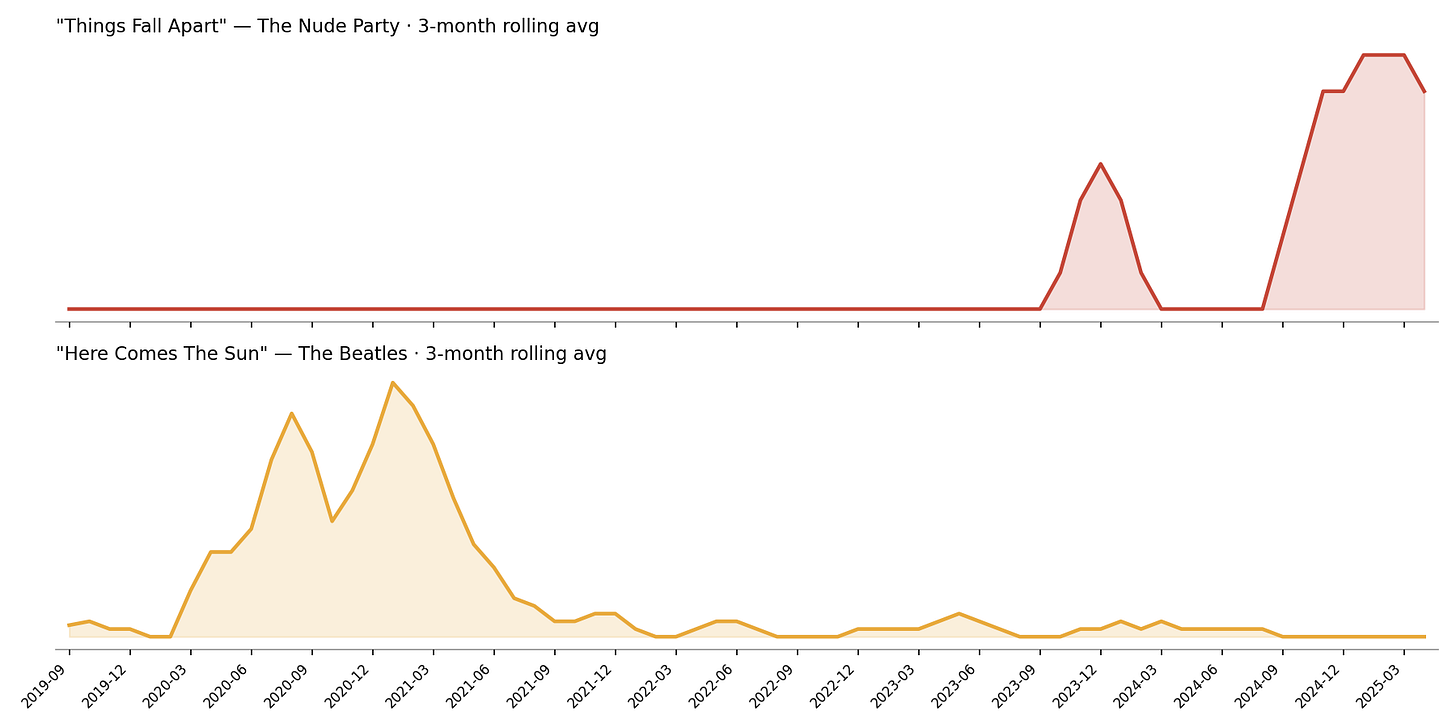
(the peaks of Here Comes The Sun suspiciously land right before the end of each UK lockdown)
Just as a litmus test can tell you whether a solution is acidic or alkaline, these songs can serve as a litmus test for my emotional and psychological state. The amount they resonate with me indicates how reflective they are of my current mood.
There’s one more ‘litmus test’ song I’d like to mention: The Killing Moon covered by Mélanie Pain and Nouvelle Vague. To me, this song feels like mystery, ambiguity, and a hint of magic. I resonate with it when I’m feeling uncertain - like I’m drifting, without knowing quite where I’ll end up. I’m not enjoying it particularly much today.
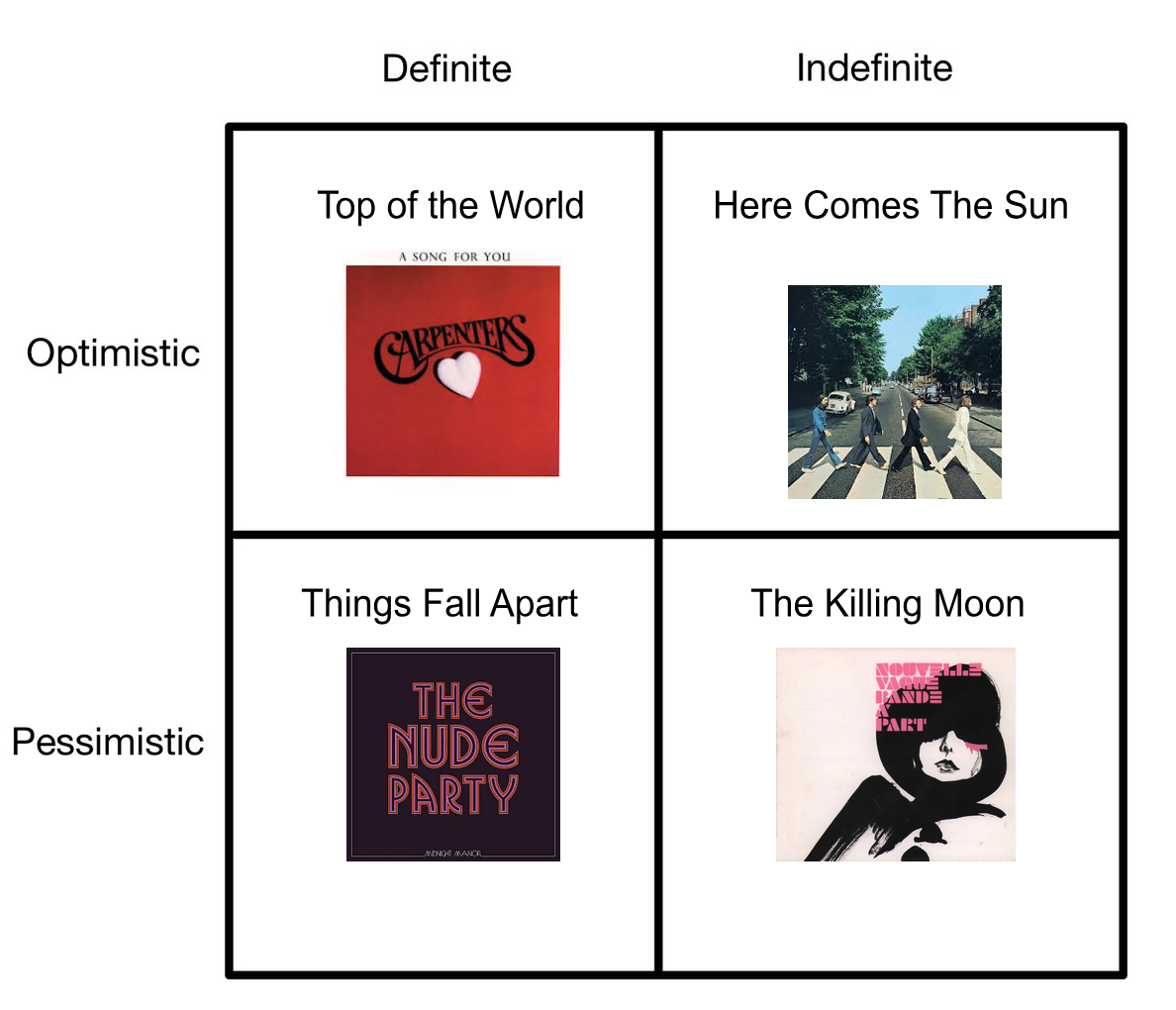
Together, we can place these songs on Palantir co-founder and evil billionaire Peter Thiel’s four quadrants - which describe the four emotions of the human experience.
And it’s not just mood that affects my perception of music. I’ve discovered that I generally enjoy music much more while sleep deprived (intoxication has a similar effect, though this is more common knowledge). I think this is because there’s less going on in my head, allowing me to pay more attention to my sensory experience .
Visual stimuli can also affect perception of music. The most obvious example I can think of here is climbing up stairs in Budapest to hear a man playing The Beatles’ Let It Be in a thick Hungarian accent as I stared at a beautifully intricate church tower (picture below). I sat down on the steps and stared at the church for at least thirty minutes as he played and sang until I heard Vance Joy’s Riptide for the third time and suspected it was maybe time to leave.

My music taste also has a habit of changing according to my romantic interests. I’ve observed multiple instances of learning to really love certain pieces of music, purely because I started to associate it with a girl I had a crush on. This may even create an appreciation of the song that lasts longer than the crush. For me, this is Purple by Wunderhorse.
On the flip side of this, there are certainly songs that are twinged with a certain kind of sadness because I associate them with a past romantic interest. A prime example of this for me is the song Can You Forgive Her? by the Pet Shop Boys. Almost two years later, and hearing it still brings me back to that drunken evening in Budapest (I believe this was the same day as the previous Hungarian anecdote).
Which brings us neatly to the real point of this essay: to demonstrate that the notion of qualia is incoherent. Qualia, as defined by philosopher Daniel Dennett, are simply the ways things seem to us (Dennett 1993). For example, the particular way that the Radcliffe Camera looks to you in the moonlight as you’re walking home at night, or the specific way that your favourite song sounds to you as it plays in the club on an Indie Friday.
Some of you may have had the fleeting thought: “When we both call an apple red, how would I know that the colour I see is the same as the colour you see? What if your green is my red?”. It is precisely this kind of questioning that I wish to attack as confused.
Consider two guys, we’ll call them Chase and Sanborn, who have just gotten out of a messy situationship. During the situationship, they both used to really love a specific song - let’s say Dancing Queen by ABBA - because they associated the song with certain memories they had together. But now that things are over, the song that used to fill them with joy, now feels empty and painful to listen to.
Chase claims: “Of course the actual sound of the song hasn’t changed, it’s purely my reactions to it that are different. What once reminded me of happy memories now reminds me of nothing but pain. I hear the same thing; it’s just the associations I have with it that colour my experience differently.”
Sanborn, however, says: “If the song sounded exactly the same to me as it did when I first heard it, I couldn’t help but enjoy it, despite the painful memories it brought up. But no, the specific sonic quality of the chords is different - I’m sure of it. They used to sound warm and bright, and now they sound thin and empty. The emotional changes I’ve experienced must have changed the way that my brain integrates new sensory information.”
I would like to suggest, (as Daniel Dennett does), that Chase and Sanborn’s claims are fundamentally confused. There is no pure ‘how the song sounds’ that can be decoupled from our reactions to it. The cloud of reactions and associations are what constitutes the particular quality of the sound we experience.
Consider how Chase and Sanborn could possibly figure out if their claims are actually true. They could think back to their memories of how it sounded to them before, but these memories again would be coloured by their newer experiences, they wouldn’t be able to know exactly the feeling that they had in the moment. They could inspect their brain with advanced neuroscience, but there’s no point in our neural circuitry where the ‘pure sound’ stops and the ‘reactions’ come in. And if there is no way of telling the difference through either first-person introspection or third-person scientific investigation, then their disagreement cannot be about anything substantive, but rather different descriptions of the same thing. There is no possible way of distinguishing between the two hypotheses that Chase and Sanborn have, therefore any disagreement about it is ultimately meaningless.
This kind of argument has led to modern day philosophers of mind like David Chalmers, lead singer of the Zombie Blues, to instead use a deflated notion of qualia (or avoid talking about it altogether), that strips it of the heavy assumptions that Dennett attacks.
But none of this gives us any clue into what is actually changing when we hear music differently. Why are some experiences of music so much more enjoyable than others? Why does my taste in music fluctuate so wildly?
In his book Sweet Anticipation, music theorist and cognitive scientist David Huron provides an attempt at explaining this, drawing on the predictive processing theory of the brain.
Predictive processing suggests that our experience of reality is not just formed through passive reception of our sensory information, but rather an active construction of our mind. In other words, everything we perceive is essentially a hallucination. Our brain is constantly generating a prediction of what’s going on in the world and the sensory data we receive acts only to ground and error-correct these predictions in a hierarchical way - from low level features like edges and tones to higher level features like objects and melodies. Without sensory data, our experience can float free from reality with surprising coherence, which is why dreams are so vivid and lifelike. The same mechanism that generates your experience while dreaming is the same thing that produces your experience while you are awake.
Drawing on this framework, Huron claims that our pleasure while listening to music can be explained by a story about prediction. He breaks this down into a 5 factor model he calls ITPRA: Imagination, Tension, Prediction, Reaction, and Appraisal.
Imagination is what we feel when we anticipate an event before it occurs - the thrill of knowing the beat is about to drop. Tension is the physiological priming that happens during moments of uncertainty or unpredictability. Prediction is the fast, unconscious response to whether your brain’s predictions were correct. Reaction is the immediate defensive assessment of whether the event was safe or threatening. And Appraisal is the slower, more considered evaluation of whether the event was actually good.
Huron posits that musical pleasure is amplified by contrastive valence - essentially the pleasure of the appraisal is made better because it comes after the badness of the immediate prediction error. Our enjoyment of music is almost masochistic: the pain of having our micro-predictions violated intensifies the pleasure of them all making sense when appraised in the larger context of the piece. I think this theory plausibly explains the feeling of chills when listening to a particularly great piece of music - the rapid succession of micro pains followed by greater pleasure.
We can use this framework to explain my earlier observations: I don’t enjoy Top of the World when I’m not happy, because it doesn’t fit with my current predictions of reality, and therefore my appraisal response judges it to be hollow. When a song is accompanied by fitting visuals, the appraisal response judges the sounds as making more sense, and therefore more dopamine is released. When I’m sleep deprived or intoxicated, the lower levels of my predictive hierarchy get more attention, and there is less top down interference being applied from higher levels, allowing me to experience the sounds in more detail and richness. And the romantic associations can be explained by the web of meanings and significance attributed to the song gradually being trained into the imagination, tension, prediction and appraisal responses, creating a change in the actual experience of hearing it, whether in a positive or negative way.
In conclusion, I hope you now understand why if you ask me what my favourite song is, I may tell you that it is impossible for me to know. My tastes fluctuate so much depending on my mental state that I often can’t tell how much I’ll like a piece of music until I hear it. And even if you got me to listen to every song in my Spotify library in sequence and pick the one I liked best, listening to certain songs would change my mental state to a significant enough degree that the songs I enjoyed most would be different than when you originally asked me the question. Anyway, I’m quite impressed you got to this point in the essay. Congratulations. I tried my best to throw curveballs at you, and you’re here anyway.
Perhaps you enjoyed your predictions getting locally violated to form a (more or less) coherent whole.